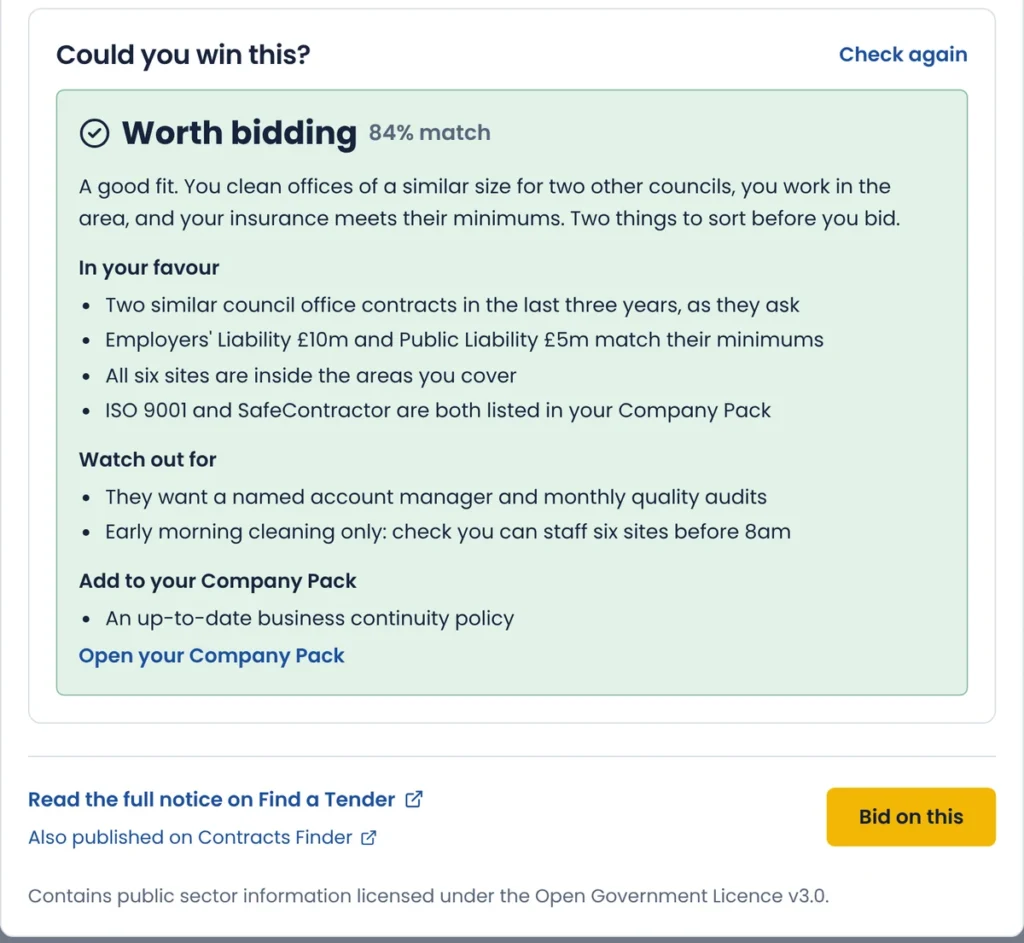
Cleaning is one of the most common services public bodies buy. Councils, academy trusts, NHS trusts, housing associations and police and fire services all put their cleaning contracts out to tender, for offices, schools, libraries, health centres and communal areas. You will find them on Find a Tender, Contracts Finder and the Scottish and Welsh sites.
What buyers ask for in cleaning tenders
- Insurance: employers’ liability and public liability, usually at set minimum levels. Check these first, because they are often pass or fail.
- Health and safety: CHAS or SafeContractor is common, plus your COSHH assessments.
- Training: BICSc training shows buyers your cleaners are trained to a recognised standard.
- Checks: DBS checks for school and care sites.
- Quality: ISO 9001 on larger contracts, or a clear description of how you check standards.
- Similar work: two or three examples of contracts like this one.
Not sure what yours should look like? There is a finished example Company Pack for a cleaning firm in the app. See cleaning tenders on Trade Tenders.
Read the TUPE information before you price
Many cleaning contracts come with TUPE, where the cleaners already doing the work move across to the new contractor on their current pay and terms. The buyer has to share details of the staff involved. Read them before you put a price on it: their hours and pay set your biggest cost.
Price it site by site
Work out the hours each site really needs, what you pay per hour, your on-costs, consumables and supervision, then add your profit. Don’t forget periodic work such as deep cleans and window cleaning. Trade Tenders reads the specification and lists each site with its hours, marking any hours it has estimated so you can check them.
Answer the quality questions with evidence
Cleaning tenders often score mobilisation (how you will start the contract), quality monitoring, staffing and cover, and social value. Our guides on writing a method statement and how buyers score your tender will help.
Mobilisation: what buyers want to see
Buyers worry most about the first few weeks of a new cleaning contract. Show them a plan: who leads it, when you visit each site, how you meet the existing staff, how you recruit and train anyone new, and what happens on day one. A simple week-by-week plan scores well.
Cover and quality
Two questions come up again and again: what happens when a cleaner is off sick, and how you know the cleaning is up to standard. Explain your relief cover, and how a supervisor checks and scores each site and puts things right.
Common mistakes in cleaning bids
- Pricing from the floor area alone, without checking the hours the current staff actually work.
- Leaving out periodic work such as deep cleans, high-level dusting and windows.
- Promising early-morning cleaning at every site without enough staff to do it.
- General answers with no examples of similar contracts.
Trade Tenders also finds grounds maintenance, pest control and waste and recycling contracts, if you offer more than cleaning.
Find cleaning tenders near you. Create your free Trade Tenders account. Your first bid is free, and you don’t need a card.